 |
| Image Credit: http://www.hongkiat.com |
According to Barndt (2011), “Our social, political and management systems are becoming more sophisticated and dependent upon effective communication.” Media technologies have adapted to how people prefer to communicate with one another through different mediums like telephones, text messages, e-mail, and video conferencing. Organizations rely upon a wider variety of supports and relationships, and larger organizations enter into collaborative relationships requiring extensive communication through new mediums.
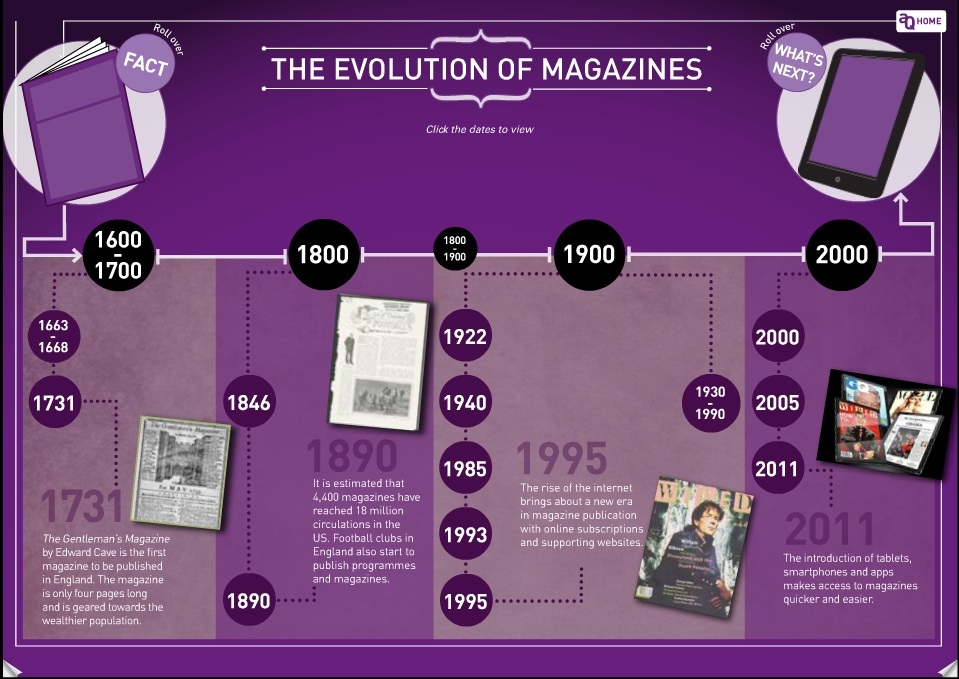
Traditional and modern media technologies have blended in several areas since the telecommunications revolution in the 1990s (Barndt). Media outlets were evolving because information was being shared through global networks at an exponential rate through the Internet. Web pages were initially very crude and didn’t include vibrant graphics or charts to assist people who are visual learners. Personal computers helped people access information in new ways, which made the television, radio, newspaper, and magazine industries adapt to stay relevant to mainstream users.
 |
| Image Credit: http://www.digitalartistdaily.com |
 |
| Image Credit: http://www.visualinformation.info |
Radio first appeared on ships in 1891 so they could communicate with land units, and reduce the feeling of isolation by crew members. The introduction of mobile radios was used to broadcast business communication between maritime, aviation, and land-based entities. In fact, companies like Marconi and Bell laboratories were creating car telephone systems from mobile radios in the 1920s. This technology eventually led to today’s cell phones and radio telephones used by the military in both World Wars. Radio’s main audiences vary based on the type of music or information they share on the air waves.
 |
| Image Credit: http://media-curse.cursecdn.com |
Early television audiences included family households who watched the evening news and other “prime time” programming. As television evolved, so did their target audiences. Cable television separated audiences by their respective interests to give them access to general programming, sports, movies, and even “reality” television. The Internet also emerged as a viable solution for cable television in the 1990s, and sites like the Internet Movie Database, or IMDb, helped people learn about cast members from their favorite television and cable series as well as motion pictures (Curtiss, 2011).
 |
| Image Credit: http://www.sequelgroup.co.uk |
 |
| Image Credit: https://m1.behance.net |
The Internet has opened up a variety of educational resources to help people share and collaborate on different concepts and ideas to increase their knowledge of different subjects. Capeless (2014) stated the Internet even helps children develop their knowledge base in constructive learning environment to help them grow as individuals. The Internet has also opened up other business opportunities for professionals to engage with one another in secure forums. Capeless (2014) suggests online users be courteous, kind, and respectful to people they communicate with on the Internet because people come from different regions and cultural backgrounds. Sharing information is encouraged, but Capeless (2014) suggests that people stay away from peer-to-peer networks where illegal audio and video content is being shared daily.
In conclusion, modern media technologies revolutionized how people communicate and receive information in the 21st century. Technologies like television, radio, newspapers, magazines, and the Internet have become integrated communication platforms for global audiences to share facts, experiences, and other business concepts in broad and innovative ways that have impact how people relate to one another and discuss personal and organizational issues. Lastly, these media technologies, along with other transformational innovations, continue to evolve as technology and communications bring people together from across the globe.
References
Capeless, D. (2014). Internet Safety & Appropriate Use of Communication Technologies. Retrieved from http://www.mass.gov/berkshireda/crime-awareness-and-prevention/internet-safety-and-appropriate-use-of-communication-technologies/internet-safety.htmlCurtis, A. (2011). A Brief History of Movies, TV and the Web. Retrieved from http://www2.uncp.edu/home/acurtis/Courses/ResourcesForCourses/Movies&Television.html
Barndt, M. (n.d.). The Telecommunications Revolution. Retrieved from https://pantherfile.uwm.edu/mbarndt/www/revolut.htm
Mass Media Course: Magazines, the Early History. (2013). Retrieved from http://www.cybercollege.com/frtv/mag1.htm
Stephens, M. (n.d.). History of Newspapers. Retrieved from http://www.nyu.edu/classes/stephens/Collier's%20page.htm

No comments:
Post a Comment