Blog purpose

This professional blog is the culmination of my educational studies and requirements to complete my bachelor's degree in Communications Studies at Ashford university. It includes research papers, discussion responses, and video presentations from a variety of courses including technical writing, media writing, communication and conflict, advanced communications, and communications in society.

Monday, December 1, 2014

ENG315: Audience Analysis

Audience Analysis
Steve Grever
Ashford University
Instructor Patricia Lake
COM315 – Business and Professional Writing
September 29, 2014

Audience Analysis

This research paper will identify and analyze the primary audience for my report on effective use of social media to express company identity. It will discuss the audience size, geographic distribution, and audience composition as well as analyze the audience’s understanding of the main topic of the report. Lastly, it will highlight the audience’s expectations and preferences and provide insight into the audience’s possible reactions to the report.

Image Credit: San Antonio Public Affairs League
The business report’s primary audience is strategic communicators and social media professionals who are part of the San Antonio Public Affairs League. There are more than 50 members in the San Antonio Public Affairs League, and many of the members work at military bases in San Antonio and in the surrounding cities like Cibolo, Schertz, Garden Ridge, and Universal City. Most of the members of the San Antonio Public Affairs League are retired from the Air Force and Army. They are military professionals who have more than 20 years of public affairs expertise that includes strategic communication, marketing, and public relations.

Public affairs league members will expect the report to include case studies, key demographics, and statistical data on current trends and best practices for using social media to increase the exposure of a company’s online identity. Wynne (2014) has stated that social media websites like Twitter are good to achieve three public relations’ goals – announcing new products, reaching how competitors are promoting their companies, and networking with other professionals in their respective industry.

Image Credit: http://www.compuclaim.com
Public affairs specialists who are members of the San Antonio Public Affairs League will need the business report to bridge the gap between traditional public affairs products like news releases, features, and video documentaries, and incorporate social media strategies that increase engagement and interaction with a company through social media outlets. Panetta (2009) suggests that social media has taken the place of traditional mediums like television and radio because it is easily accessible and provides real-time information to a global audience. Mascott (2013) states that companies need to understand how engaging with a global audience can maximize conversations about their brand and products.

League members will most likely have a mixed reaction to the business report because of their own individual and professional experiences in public affairs and social media. They will question the data and its relevance to public affairs operations. They may also try to integrate the researched information in the report into their current strategic communication plans, and identify pitfalls that may show deficiencies in the report and data as a whole. According to MacArthur (2014) “word-of-mouth” marketing through social media may also be a key strategy that public relations professional should consider if they want to have a credible social media program. Overall, the business report should provide comprehensive and compelling research and data to help them understand the importance of using social media tactics and strategies to increase their company’s brand and online presence.

In conclusion, this research paper identified the primary audience for my report on effective use of social media to express company identity. It discussed the audience size, geographic distribution, and audience composition and analyzed the audience’s understanding of the main topic of the report. Lastly, it highlighted the audience’s expectations and preferences and provided insight into the audience’s possible reactions to the report.

References
Bovée, C. L., & Thill, J. V. (2014). Business communication today (12th ed.). Pearson.

MacArthur, K. (2014). Social media, marketing and the power of 'word of mouth' - Chicago Tribune. Retrieved from http://www.chicagotribune.com/bluesky/originals/chi-qa-suzanne-fanning-social-media-week-bsi-story.html

Mascott, J. (2013). How Should Organizations Approach Social Media? | Public Affairs Council. Retrieved from http://pac.org/news/comm/how-should-organizations-approach-social-media

Panetta, M. (2009). Social Media for Public Affairs. Retrieved from http://www.slideshare.net/mikepanetta/wasrgsocialmediapublicaffairs

Social Media Best Practices | Resources | Public Affairs | Illinois. (2014). Retrieved from http://publicaffairs.illinois.edu/resources/socialmediabestpractices.html

Wynne, R. (2014). Twitter for Public Relations: Fact and Fantasy - Forbes. Retrieved from http://www.forbes.com/sites/robertwynne/2014/09/22/twitter-for-public-relations-fact-and-fantasy/

Week 5 discussion: Top communication associations

The top communications organizations for professionals to integrate with include the National Communication Association, the American Communication Association, Association for Business Communication, Society of Professional Journalists, and the Online News Association. Each of these organizations were founded to bring together professional communicators from around the world to network and share their insights on the future of the communications and journalism industries.


National Communication Association

The National Communication Association promotes “free and ethical communication” and partners with other esteemed organizations like the American Council of Learned Societies, Consortium of Social Science Associations, and the Council of Communications Associations. Their target audience includes scholars, teachers, and other educational practitioners who focus on research and teaching.


American Communication Association

While a bit younger than other associations, the American Communication Association works to promotion scholarly works in human communication, communication law and policies, and other evaluation and certification services. The organization focuses on professionals around the world with a background in education and evolving communications technologies. Some of its values includes freedom, openness, transparency, and equality.


Association for Business Communication

The Association for Business Communication is an international organization that works to advance “business communication research, education, and practice.” Its main goals are to strengthen business communication strategies, establish outreach services for its members, and ensure a deep level of ‘internationalization” throughout the organization. The group targets members who work in communication professions to prepare students to improve communication in the workplace.


Society of Professional Journalists

This world-renowned organization began more than 100 years ago to guarantee that the rights of journalists under the First Amendment were guaranteed to them to report the news objectively. They also work at the local and national levels to facilitate requests through the Freedom of Information Act, as well as supports other grass-roots initiatives. The target audience includes professional journalists, journalism educators and students. Membership includes professional development opportunities, access to more than 250 local chapters around the country, and other networking and collaboration options with other communications professionals.


Online News Association

Lastly, the Online News Association provides training and networking opportunities to keep communications and news professionals update on the latest trends related to online journalism. It began in 1999, and serves professional producers, content editors, news directors, reporters, bloggers, and other newsroom decision makers. Membership includes training camps, annual conference, online webinars, and other retreats and chapter meetings.


References

About ACA | The American Communication Association. (2014). Retrieved from http://www.americancomm.org/about-aca

About - Online News Association. (2014). Retrieved from http://journalists.org/about

Association for Business Communication. (2014). Retrieved from www.businesscommunication.org/about

Society of Professional Journalists | Improving and protecting journalism since 1909. (2014). Retrieved from http://www.spj.org

What is the National Communication Association? (2014). Retrieved from https://www.natcom.org/about

Tuesday, November 25, 2014

ENG 315 Business Report Presentation Video


This presentation identifies effective uses of social media to express a company's respective identity online. It provides social media strategies for improving communication programs, online top social media channels, and illustrates current trends and best practices.

Thursday, November 20, 2014

Week 4, Discussion 2: Top 5 career fields

Image Credit: http://usaa.com

Customer service
One of the fastest growing occupations in San Antonio involves customer service. People who work in customer service jobs can work in a variety of businesses as the liaison between an organization and customers. Some also have dual roles in selling products for companies at retail stores. I've seen many customer service representatives at brick-and-mortar storefronts like T-Mobile, Verizon, and Ashley's Furniture. According to the Bureau of Labor Statistics (2013), there are more than 26,000 customer service representatives who make about $13.78 hourly, which adds up to about $28,660 annually.

Image Credit: http;//www.udc.edu
Human resources
Another trending career field is human resources in San Antonio. Human resources is a diverse industry of professionals who work with managers and employees to resolve labor-related issues. They are also called upon to resolve conflicts, and counsel company members on benefits and competitive compensation. The Bureau of Labor Statistics (2013) states that  human resources specialists and assistants make about $18 hourly, which adds up to $37,390 annually.

Image Credit: http://wildrockpr.com
Public Relations
One of my preferred career fields is public relations. Public relations specialists can be hired as a public affairs specialist for the military and government or as a public information officer for government organizations. they also can fill marketing and community relations positions at commercial organizations. According to the Bureau of Labor Statistics (2013), public relations specialists in san Antonio make about $23 hourly, which adds up to $47,790 annually.

Image Credit: http://palmeradagency.com
Advertising
Working in the advertising and marketing industry opens up many possibilities for using the skills I learned as part of my Communications Studies program. Advertising involves creating marketing campaigns using online, print, and television advertising strategies to reach out to potential customers with consumer products. According to the Bureau of Labor Statistics (2013), advertising supervisors can make between $21 and $32 hourly or between $45,000 and $66,000 annually.

Image Credit: http://idratherbewriting.com
Technical writing
Another one of my favorite career fields in the communications industry is technical writing. Technical writings draft communication products that are used to explain concepts involving computer hardware and software, engineering, chemistry, aeronautics, and robotics. It requires a communication specialist to learn not only the fundamentals of writing, but also incorporate the ability to learn and relay new information about technical innovations. According to the Bureau of labor Statistics (2013), technical writers earn about $32 hourly, which adds up to about $67,900 annually.

Of all the career fields I described above, my favorite to have a long-term career in would be public relations. I've worked in public affairs for the Air Force for 17 years, and I like how the industry has evolved to include more online communication that also involves social media. While I like writing news stories and features, I also like creating social media plans and strategies to engage with the general public about the Air Force.

References
Occupational Employment and Wages in San Antonio–New Braunfels, May 2013 : Southwest Information Office : U.S. Bureau of Labor Statistics. (2013). Retrieved from http://www.bls.gov/regions/southwest/news-release/occupationalemploymentandwages_sanantonio.htm

Monday, November 17, 2014

Week 3 assignment: Delivering bad news

Image Credit: http://georgetownexec.com
Communicating with employees who are displaying a confrontational behavior at work require supervisors to be assertive in addressing their inappropriate behavior to make them productive members of the organization’s team. Managers need to be proactive in anticipating the employee’s response, and Cahn and Abigail (2007) suggest they use a six-step confrontation process to come to a mutual agreement to resolve the issue.

Image Credit:
http://conflictres.acu.edu/
The first step to helping confrontational employees is to research their problems and ask the “who, what, where, when, and how” questions (Cahn and Abigail, p. 84). Finding the answers to these five basic questions will set the foundation for understanding the root cause of the employee’s poor behavior. After determining the root causes of the employee’s issues, the supervisor will need to schedule a time to have a private meeting with the individual about their behavior. Cahn and Abigail (2007) refer to this stage as the “initiation stage” because both parties need to agree on a specific date and time to meet and discuss the issue.

When the meeting occurs, the supervisor will begin the meeting, and consider their non-verbal communication techniques like sitting up tall, looking at the person, but not staring, and speaking firmly and assertively to the employee about the issue at hand. Cahn and Abigail (2007) suggest they use their knowledge of the issue to anticipate how the employee will response. They should also verbalize what their personal views and concerns are to allow the employee to have a baseline for how to respond. Using “I-statements” are also beneficial to ensuring communication is clear, concise, and assertive enough to impact the employee’s demeanor so they are honest and forthcoming about their negative behavior.

The fourth stage of the Cahn and Abigail’s (2007) states that supervisors should have empathy for their subordinates, and take into account their beliefs and feelings regarding their work environment and personal behavior issues. The old adage, “Put yourself in their shoes,” applies to these confrontational situations because it reminds the supervisor to their about the situation from their employee’s perspective. It helps them formulate proposed recommendations for resolving the conflict at work too. The final stage is the most critical, according to Cahn and Abigail (2007) because both parties need to come together to agree on a mutually beneficial agreement that meets both the supervisor and employee’s goals for the meeting. The supervisor will need to ensure the agreement is accomplished in writing, which can be filed in the employee’s personnel record for use later if they are being considered for dismissal because of multiple infractions. Formal agreements can also be finalized using a mediator who can help both parties communicate their goals and concerns as well as the final written agreement to resolve the issue.

Lastly, the final step includes scheduling a timeline for both parties to come back to the table to see if the recommended solution worked and was implemented properly (Cahn and Abigail, 2007). Reviewing the employee’s performance and adherence to the written agreement will let the supervisor know if their resolution was beneficial for the company and the employee. The follow-up meeting can also be a forum for the supervisor and employee to request amendments to the agreement, which will help them sharpen the focus of their long-term goals.

In conclusion, communicating with employees who are displaying a confrontational behavior at work require supervisors to be assertive in addressing their inappropriate behavior to make them productive members of the organization’s team. Managers need to be proactive in anticipating the employee’s response, and use a six-step confrontation process to come to a mutual agreement to resolve the issue.

References
Cahn, D.D., & Abigail, R.A. (2007). Managing conflict through communication (4th ed.). Boston, MA: Pearson Education, Inc. ISBN: 978-0-205-68556-1

Thursday, November 13, 2014

Week 3 assignment: Overcoming cultural differences

Image Credit: http://www.slideshare.com
Hahn (2005) identifies several guidelines for communicating with people from other backgrounds that will be useful to adopt in work centers. He suggests that creating an environment for different cultures to flourish, and for everyone to accept each others differences in a positive, open forum. When people engage one another about their respective cultures, including religious beliefs, it allows them to connect in a different way, which could increase productivity and team cohesion.

Hahn (2005) suggests that people have an awareness of each person's individual space and be aware of their comfort zones in a business environment. He also added that employees should understand the organizations policies on legal and ethical behavior to ensure they are following the appropriate guidelines for how to treat people with language barriers and other cultural differences.

The most effective way to address cultural differences in the workplace is to be respectful, flexible, patient, and clear in communicating your needs. Try to empathize with their cultural challenges, and try to relate to their situation to find common ground to send and receive messages properly (Hahn, 2005).

Image Credit: http://www.saludtoday.com
We had an extensive diversity program at my last organization that emphasized bridging gaps between cultural differences in the workplace.The program also created opportunities for each employee to learn about how high-context and low-context cultures. High-context cultures use less verbal communication in favor of nonverbal actions in the workplace, while low-context cultures depend on oral communication and implied meanings to get their messages across at work (Hahn, 2005).

Having a clear understanding of cultural boundaries, and how to overcome them, lead to our organization having a judgement-free environment for employees to thrive and ultimately help the company achieve its mission and goals.

Reference
Hahn, M. (2005). Ten Commandments of Intercultural Communication. Retrieved from http://ezinearticles.com/?Ten-Commandments-of-Intercultural-Communication&id=120247

Monday, November 10, 2014

Week 2 assignment: Media technologies

Image Credit: http://www.hongkiat.com
Modern media technologies have revolutionized how people communicate and receive information in the 21st century. Technologies like television, radio, newspapers, magazines, and the Internet have become integrated communication platforms for global audiences to share facts, experiences, and other business concepts in broad and innovative ways that have impact how people relate to one another and discuss personal and organizational issues. Lastly, these media technologies, along with other transformational innovations, continue to evolve as technology and communications bring people together from across the globe.

According to Barndt (2011), “Our social, political and management systems are becoming more sophisticated and dependent upon effective communication.” Media technologies have adapted to how people prefer to communicate with one another through different mediums like telephones, text messages, e-mail, and video conferencing. Organizations rely upon a wider variety of supports and relationships, and larger organizations enter into collaborative relationships requiring extensive communication through new mediums.

Traditional and modern media technologies have blended in several areas since the telecommunications revolution in the 1990s (Barndt). Media outlets were evolving because information was being shared through global networks at an exponential rate through the Internet. Web pages were initially very crude and didn’t include vibrant graphics or charts to assist people who are visual learners. Personal computers helped people access information in new ways, which made the television, radio, newspaper, and magazine industries adapt to stay relevant to mainstream users.

Image Credit: http://www.digitalartistdaily.com
According to Stephens, there were about 1,600 daily newspapers in the United States in 1990, which is about 14 percent less than how many newspapers were available in 1940 before Americans started putting television sets into family households. Newspapers have made several evolutionary jumps over the last century after television, Internet, and advancements in wireless communications technologies made daily news and information easier to access. Instead of several localized newspapers, many publishing companies created regional papers to cover news across counties and even states. Newspapers reached many types of audiences from educated scholars to elementary school students. Each section of a newspaper caters to different people with specific interests like sports, comics, or the local lifestyle section. They began to focus specifically on features versus straight news articles because people heard about breaking local news on television and radio outlets (Stephens).

Image Credit: http://www.visualinformation.info

Radio first appeared on ships in 1891 so they could communicate with land units, and reduce the feeling of isolation by crew members. The introduction of mobile radios was used to broadcast business communication between maritime, aviation, and land-based entities. In fact, companies like Marconi and Bell laboratories were creating car telephone systems from mobile radios in the 1920s. This technology eventually led to today’s cell phones and radio telephones used by the military in both World Wars. Radio’s main audiences vary based on the type of music or information they share on the air waves.

Image Credit: http://media-curse.cursecdn.com
Television was initially invented in 1927 by Philo Fansworth, and wealthy people who could afford it made the transition from radio to TVs (Curtis, 2011).  The U.S. government established the Federal Communications Commission in 1946 to regulate public television broadcasting in the United States. It didn’t take long for cable and network television to make waves in other areas like the motion picture industry. In fact, movie makers fought back by creating multi-screen theaters to entice people to come back and watch movies on larger screens away from their homes.

Early television audiences included family households who watched the evening news and other “prime time” programming. As television evolved, so did their target audiences. Cable television separated audiences by their respective interests to give them access to general programming, sports, movies, and even “reality” television. The Internet also emerged as a viable solution for cable television in the 1990s, and sites like the Internet Movie Database, or IMDb, helped people learn about cast members from their favorite television and cable series as well as motion pictures (Curtiss, 2011).

Image Credit: http://www.sequelgroup.co.uk
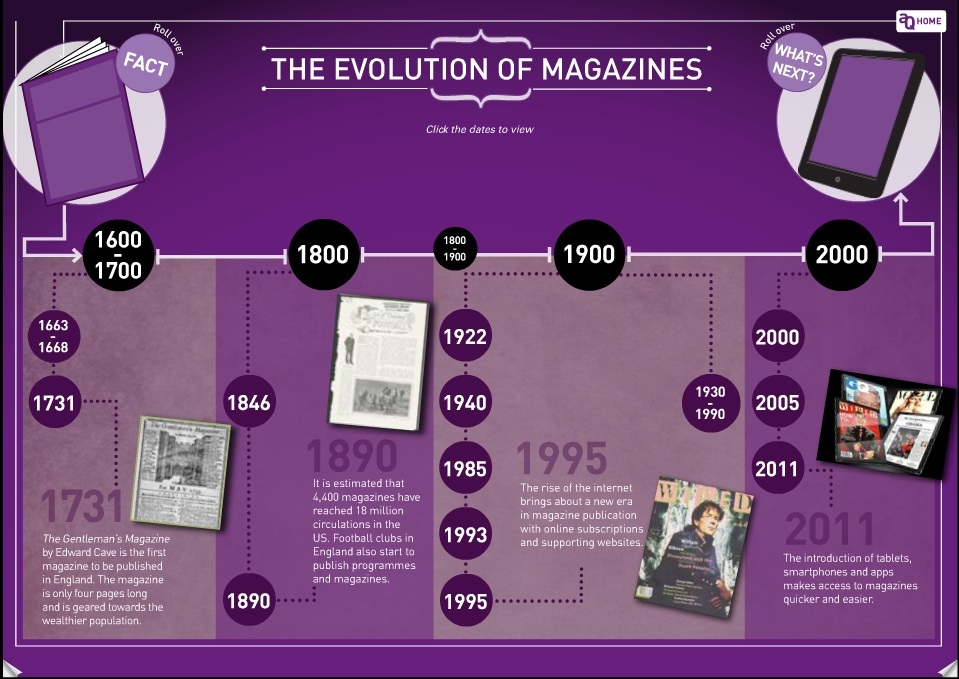
One lesser media technology that appealed to audiences with specific interests were magazines. Magazines were different from newspapers and newsletters because they went more in-depth on specific topics that focused on content for niche audiences. One of the first magazines in existence was created in 1704 in London, England. The first U.S. magazine was the Saturday Evening Post, and it wasn’t published until 1821. While the Saturday Evening Post focused on creating on general interest topics, Life Magazine’s claim to fame was its staff of top photographers who won many awards for their imagery. Magazines make their money from advertising, subscriptions, and single-copy sales. Many magazines have been forced to reduce production costs, and move their product online. This reduced circulation, postage, and publishing costs significantly. However, the magazine industry is still having issues making a profit online because web users are used to free content, instead of paying monthly subscriptions.

Image Credit: https://m1.behance.net

The Internet has opened up a variety of educational resources to help people share and collaborate on different concepts and ideas to increase their knowledge of different subjects. Capeless (2014) stated the Internet even helps children develop their knowledge base in constructive learning environment to help them grow as individuals. The Internet has also opened up other business opportunities for professionals to engage with one another in secure forums. Capeless (2014) suggests online users be courteous, kind, and respectful to people they communicate with on the Internet because people come from different regions and cultural backgrounds. Sharing information is encouraged, but Capeless (2014) suggests that people stay away from peer-to-peer networks where illegal audio and video content is being shared daily.

In conclusion, modern media technologies revolutionized how people communicate and receive information in the 21st century. Technologies like television, radio, newspapers, magazines, and the Internet have become integrated communication platforms for global audiences to share facts, experiences, and other business concepts in broad and innovative ways that have impact how people relate to one another and discuss personal and organizational issues. Lastly, these media technologies, along with other transformational innovations, continue to evolve as technology and communications bring people together from across the globe.

References
Capeless, D. (2014). Internet Safety & Appropriate Use of Communication Technologies. Retrieved from http://www.mass.gov/berkshireda/crime-awareness-and-prevention/internet-safety-and-appropriate-use-of-communication-technologies/internet-safety.html

Curtis, A. (2011). A Brief History of Movies, TV and the Web. Retrieved from http://www2.uncp.edu/home/acurtis/Courses/ResourcesForCourses/Movies&Television.html

Barndt, M. (n.d.). The Telecommunications Revolution. Retrieved from https://pantherfile.uwm.edu/mbarndt/www/revolut.htm

Mass Media Course: Magazines, the Early History. (2013). Retrieved from http://www.cybercollege.com/frtv/mag1.htm

Stephens, M. (n.d.). History of Newspapers. Retrieved from http://www.nyu.edu/classes/stephens/Collier's%20page.htm